Nature Blurbs for Captions, Journals, and Creative Projects
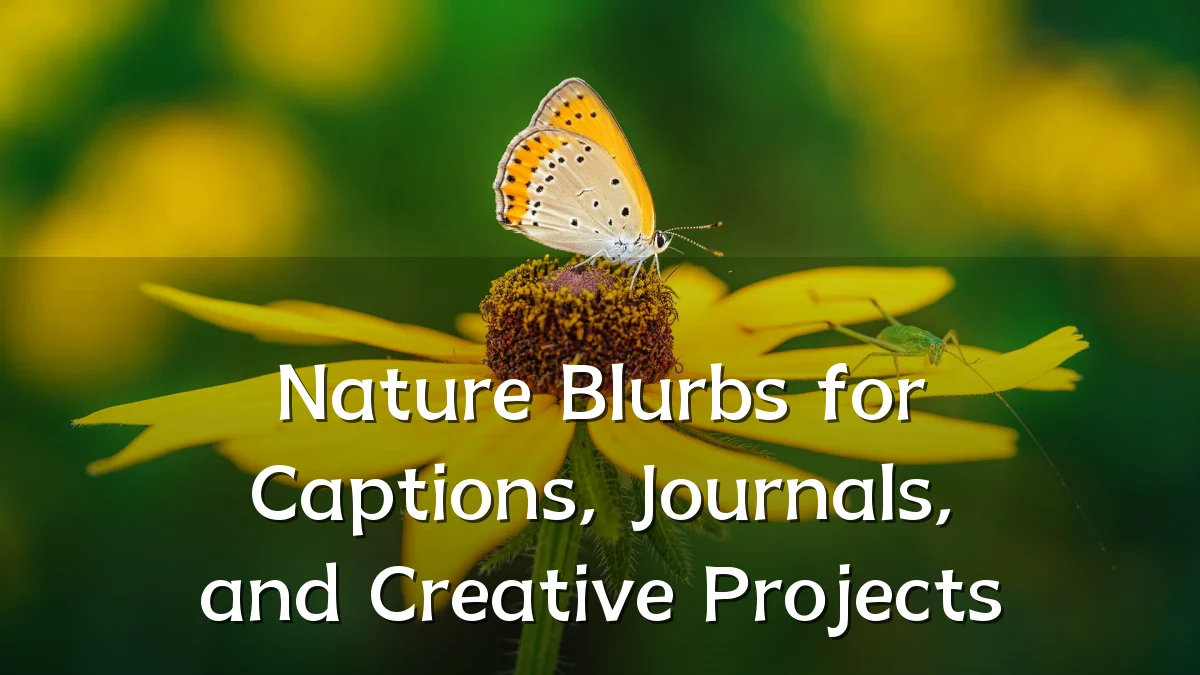
Finding the right words for a nature moment can be surprisingly difficult. A photo of fog in the trees, a quiet walk after rain, or a bright patch of wildflowers may feel clear in memory but hard to describe without sounding too grand, too plain, or too much like something everyone has already written.
Nature blurbs help bridge that gap. They are short pieces of descriptive writing that can fit under a social caption, inside a journal, on a mood board, in a scrapbook, or as a prompt for a larger creative project. The best ones do not try to explain all of nature at once. They capture one small, honest observation.
What Makes a Nature Blurb Work
A strong nature blurb usually begins with attention. Instead of writing broadly about “the beauty of nature,” it notices something specific: pine needles holding rain, the sound of dry grass underfoot, shadows moving across a lake, or the way evening light turns a path gold.
Short nature writing works best when it feels grounded in the senses. Sight is the easiest sense to reach for, but sound, smell, texture, and temperature often make a blurb feel more lived-in. A line about cold air on your hands can feel more personal than a general statement about winter.
It also helps to let the mood lead the wording. A beach at sunrise might feel peaceful, lonely, hopeful, or restless depending on the day. The same setting can support many blurbs if the emotion is clear.
Practical Examples of Nature Blurbs
These examples are meant to show different tones and uses. Some are simple enough for captions, while others may fit better in journals, art projects, or reflective writing.
- Morning settled softly over the field, and every blade of grass seemed to be holding a little light.
- The trail was quiet except for birdsong and the steady sound of my own steps.
- Rain changed the whole forest, darkening the bark and bringing the earth back to life.
- The lake held the sky so still it felt like the world had paused to breathe.
- Even the smallest wildflower seemed determined to be seen.
- Wind moved through the trees like a thought passing gently through the day.
- The mountains did not ask for attention; they simply stood there, patient and complete.
- There was a kind of peace in watching the clouds drift without needing to know where they were going.
- Sunset softened every edge, turning an ordinary path into something worth remembering.
- The garden was not perfect, but it was alive in all the best ways.
For a more personal style, add a small detail from the actual moment. “The trail was quiet” becomes more memorable when paired with something only you noticed, such as damp leaves, a crooked fence, or the smell of cedar after rain.
Common Mistakes When Writing Nature Blurbs
One common mistake is making every nature moment sound enormous. Words like majestic, breathtaking, magical, and stunning can be useful, but they lose strength when used too often. Sometimes “the pond was still” is more effective than a dramatic sentence that tries too hard.
Another mistake is writing in a way that does not match the setting. A playful caption for a muddy hike can feel more natural than a polished poetic line. A quiet journal entry about grief or rest may need slower, simpler language.
It is also easy to rely on familiar phrases: “lost in nature,” “take only memories,” “chasing sunsets,” or “nature’s masterpiece.” These can work in casual contexts, but if you want the blurb to feel fresh, change one part of the phrase or replace it with an actual observation from the scene.
Finally, avoid overexplaining the feeling. If the image or detail already suggests calm, wonder, or solitude, let it stand. A short blurb often works because it leaves room for the reader to feel something on their own.
How to Choose the Right Blurb for the Right Use
For social captions, shorter blurbs usually work better. A single clear line can support the image without competing with it. If the photo is bright and simple, choose language that is equally clean. If the image is moody or textured, a more reflective line may fit.
For journals, give yourself more space. A nature blurb can begin as one sentence and grow into a memory: where you were, what the air felt like, what you were thinking, and why the moment stayed with you. Journal blurbs do not need to be polished; they need to be true.
For creative projects, consider the role of the blurb. On a collage, it may act as a title. In a photo book, it may guide the mood of a page. In a poem or short story, it may become the seed of a scene. Choose words that leave enough openness for the project to expand.
A useful test is to read the blurb aloud. If it feels too stiff, shorten it. If it feels too vague, add one concrete detail. If it sounds unlike you, rewrite it in the way you would naturally describe the moment to someone close to you.
Simple Ways to Write Your Own Nature Blurbs
Start with what is actually in front of you. Name one object, one movement, and one feeling. For example: “fern,” “unfolding,” and “quiet” can become, “A fern unfolded beside the path, quiet as a secret.”
You can also use contrast. Nature is full of it: soft moss on hard stone, bright flowers under a gray sky, birdsong in an empty field, warm sun with cold wind. Contrast gives a short blurb shape without needing many words.
Another approach is to write from the body. Ask what the moment felt like physically. Were your shoes wet? Was the air heavy? Did the sun make you squint? Did the wind push your hair across your face? These details make nature writing feel immediate.
If you are stuck, use a simple sentence frame and adjust it until it feels natural:
- The day felt like _____.
- I noticed _____ before I noticed anything else.
- The _____ moved as if _____.
- There was something _____ about the way _____.
- I came for _____ and left with _____.
Closing Thoughts
Nature blurbs do not need to be elaborate to be meaningful. A clear image, a real feeling, and a few specific details are usually enough. Whether you are writing a caption, filling a journal page, or shaping a creative project, the goal is not to describe nature perfectly. It is to notice one small part of it honestly and give that moment a place to live in words.